LASIK for High Power Specs Removal in Mumbai — Sentra Clinic, Malad East
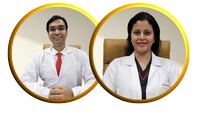
Wearing thick glasses for –6, –8, –10 or higher myopia is one of the most limiting visual situations in modern life — socially, professionally and practically. You cannot swim, play sport, wake up in the morning or travel without depending on glasses or lenses. At Sentra Clinic, Malad East, Dr. Rohit Modi (FRCS Glasgow, ICO Fellowship) offers a complete roadmap to spectacle freedom for high myopes — from LASIK and Contoura Vision for moderate-to-high powers to ICL (implantable collamer lens) for very high numbers or thin corneas.
The key message: having a high number (–6 to –20) does not automatically disqualify you from specs removal surgery. It simply requires a more thorough evaluation — and Dr. Modi has performed over 10,000 refractive procedures, including complex high-myopia corrections.
👓 High number glasses? Find out which procedure gives you spectacle freedom.
Which Procedure Is Right for Your Number?
LASIK / Contoura Vision (–1 to –8, up to –10 in select cases)
Blade-free femtosecond LASIK reshapes the cornea with an excimer laser to permanently correct your refractive error. Contoura Vision adds topography-guided treatment — mapping 22,000 points on your corneal surface to personalise the correction. Suitable up to approximately –8 D (sometimes –10 D if corneal thickness is adequate). The evaluation tests corneal thickness, curvature and pupil size to confirm suitability. Not suitable if cornea is thin or irregular (keratoconus).
ICL Surgery (–8 to –20, or LASIK-ineligible at lower numbers)
Implantable Collamer Lens (ICL, brand name EVO Visian) — a soft lens implanted between the iris and natural lens, inside the eye. No corneal tissue is removed — making it the safer option for high myopia, thin corneas, or dry eye patients who are unsuitable for LASIK. ICL provides excellent quality of vision — often better than contact lenses — and is reversible (the lens can be removed if needed, though this is rarely required). Dr. Modi performs ICL surgery routinely at Sentra Clinic.
Why High Myopia Patients Need a Specialist
- Corneal thickness matters: Every dioptre of correction requires removing approximately 12–15 microns of corneal tissue. For –10 D, that's ~120–150 microns. A minimum safe residual stromal bed of 250–280 microns must remain. If your cornea is not thick enough for the full correction, LASIK is not safe — ICL is the right choice.
- Keratoconus screening is essential: High myopes have a higher prevalence of subclinical keratoconus. Corneal topography must screen for this before any refractive surgery. LASIK on undetected keratoconus causes severe, progressive vision damage. At Sentra, every patient gets topography — non-negotiable.
- Retinal health check for high myopes: High myopia stretches the retina. Before refractive surgery, a dilated retinal examination is mandatory to check for lattice degeneration, thin areas or holes. These must be treated (laser barrage) before LASIK or ICL to prevent retinal detachment.
- Dry eye assessment: LASIK affects corneal nerves and can worsen pre-existing dry eye for 6–12 months. High myopes with dry eye are better served by ICL, which does not cut corneal nerves. Tear film quality is always assessed pre-operatively.
High Myopia Specs Removal — Patient Stories
"I was –9.50 in both eyes and had been told by two centres that I wasn't suitable for LASIK because of thin corneas. Dr. Modi agreed with that — but he did my ICL surgery instead. The difference is indescribable. I swim, I wake up seeing the clock, I travel without a spectacles case. ICL was the right answer and Dr. Modi was the right doctor to trust."
— Aditi Kulkarni, Malad East · –9.50 D Both Eyes — ICL Surgery"–7.75 both eyes with astigmatism. Contoura Vision at Sentra. Dr. Modi showed me my corneal topography map and explained exactly how the topography-guided treatment would address my specific astigmatism pattern. Post surgery: 6/6 in both eyes, zero halos, zero starbursts. I had tried daily disposables for 10 years and this was simply a better life."
— Rahul Mehta, Goregaon West · –7.75 D with Astigmatism — Contoura VisionSentra Clinic Refractive Surgery — Numbers
Frequently Asked Questions — High Myopia Surgery
Can LASIK correct –10 or –12 power?
LASIK can potentially correct up to –10 D if corneal thickness is adequate and topography is normal. Beyond –10 D, corneal thinning post-LASIK typically takes the residual bed below safe limits. For –10 D and above, ICL is generally the safer and more effective choice — it has no corneal removal and can correct up to –20 D.
Is ICL surgery safe for very high numbers like –15 or –18?
Yes — ICL is specifically designed for high myopia that LASIK cannot safely treat. The EVO Visian ICL can correct up to –20 D. The key pre-operative requirements are: adequate anterior chamber depth (space inside the eye for the lens), normal endothelial cell count (inner corneal cells), and no cataract. Dr. Modi evaluates all these parameters at your pre-op assessment.
I'm –8 D — should I choose LASIK or ICL?
At –8 D, both options may be viable depending on your individual eye parameters. If your corneal thickness allows a safe LASIK correction and your topography is normal, LASIK is simpler. If corneal thickness is borderline, topography shows any irregularity, or you have dry eye, ICL is the safer choice. Only a proper screening can answer this definitively — there is no one-size-fits-all answer at –8 D.
Will I need glasses at all after LASIK/ICL for high myopia?
After LASIK or ICL for distance correction, most patients achieve 6/6 or 6/9 vision. Near vision (reading) remains clear for patients under 40. After 40, presbyopia (age-related near vision loss) progresses naturally regardless of whether you had specs removal surgery — reading glasses may be needed for near work as presbyopia advances, the same as any person without myopia.
👓 High number specs? There is a solution. Get screened.